Showing posts with label Munich. Show all posts

Sunday, October 28, 2012

Waking up to a winter wonderland and porcini on toast

Over the last few weeks the temperatures in Munich dropped from golden, 25-degree autumn sunshine to below zero. I've been collecting coats and gloves, as well as hats and socks and scarves for my first winter in Europe - and now I think I've already used them all in one weekend.

I've been out and about in the snow to run errands over the weekend and quickly learned that a hat with a rim and a good coat work better than an umbrella or a beanie when it snows. The rim of a hat keeps the snowflakes from getting into my eyes (believe me, it hurts!) and, since it's too cold for the ice to melt, I can simply 'dust' off the snowflakes on my coat whenever I reach my destination.

Last night when I walked home after dinner with friends, the sidewalk was already covered in snow dust and I also noticed a thick layer of snow icing the autumn leaves and cars outside. So this morning I couldn't wait to see the winter wonderland in the daylight. It's the season's first snow and it's fairy tale pretty.
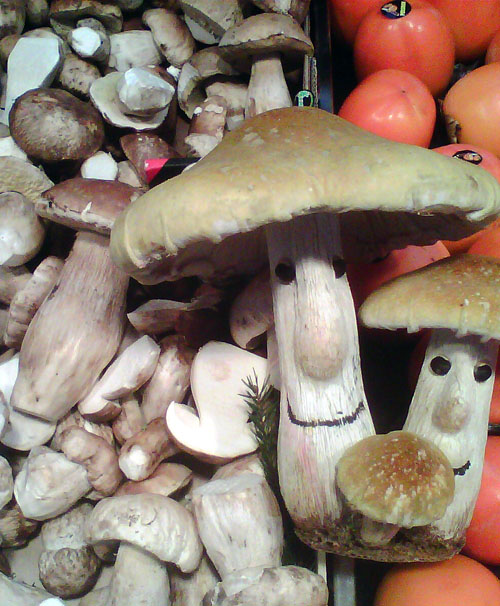
One of the greatest pleasures about living in Europe is the seasonal ingredients I can pick up at the open air markets on my way through the central city. Seasons are truly embraced here in Bavaria and meals (even restaurant menus) are planned around the local ingredients available at the time. At the moment porcini mushrooms abound and you can also pick them in the forests yourself if you know what to look for.

In Germany they are called Steinpilz (stone mushrooms) and I love how the vendor around the corner from my office carves little characters into his porcini display.

This morning I celebrated the snow with some of the mushrooms I bought from this stall, sautéed in butter and relished on toasted Bauernbrot (farmer's rye bread) for breakfast. Apparently these mushrooms also have powerful anti-viral properties, which is a perfect health perk for me as my body gets used to this sudden drop in temperature.

Everything is so quiet when it snows. Almost like a hush that highlights special moments such as unwrapping the brown paper from my fresh porcino mushrooms and savouring the aromas as it melts into the butter - and later, in my mouth.

I've saved a few mushrooms for making pasta later so I can set off its earthy, nutty flavours with a glass of red wine, or a little grappa, as the afternoon unfolds.


Wednesday, October 10, 2012

Rollercoasters and bubbles at the Oktoberfest

Yes, you can have a wild time at the Oktoberfest without drinking any beer at all. Beer, of course, is the main ingredient and Munich's six famous breweries each have a sought after tent set up for entertaining the festival goers with Oompah bands and an abundance of delicious Bavarian food.

However, there's a whole festival going on outside the tents, with rollercoasters and games, as well as food and wine and cocktail stalls spread out across the Therisienwiese festival grounds.

I can't help thinking that it might be a bit dangerous to walk underneath those rollercoasters.Just because I can imagine how I would feel up there after a couple of those massive beers. However, I do think the rollercoaster riders are probably well regulated by the German officials. Still, better safe than sorry.

Then, of course, there is also the sparkling wine tent named after Munich's own version of bubbly, called Nymphenburg Sekt. Here they serve a variety of different wines, sparkling wines and champagne paired with gourmet food.

I didn't make it to the Weinzelt this time unfortunately. Perhaps because I haven't made too many wine drinking friends in Munich. I've also been told that that the wine crowd can be quite schiki-micki (snooty) - but, hey, if someone wants to think I'm posh because I like to drink bubbles, then that's totally ok.

It is, in fact, a relief to see women all around the Wiesn standing around with glasses of wine and bubbles from the stalls. I do tend to agree with my Cape Town friends who insist that wine and bubbles are a lot more feminine than beer.

They were horrified to hear that I drink beer in Munich: "But, uhm, that's just not very sexy at all!"

I've been throwing myself into the Munich beer culture in order to experience the city in a truly authentic way. While I still struggle with the jugful quantities I find that I actually like dark beers most. It really is a special experience to sit in a beer garden under the chestnut trees, or at a beer tent at the Oktoberfest trying to master the Maß.

And yet, I'm still a wine aficionado at heart.


Saturday, October 6, 2012

Oktoberfest party at the Paulaner

It always helps to know the locals. A proper table reservation at the Oktoberfest in Munich needs to be made months in advance. However, with a little luck, my Bavarian friends invite me to a sit down dinner at the Armbrustschützen festival tent, where the Paulaner brewery celebrates the Wiesn.

Not that we sit down for long. The reservation is for around 4pm and after the first round of beer, a host of Bavarian snacks makes it to our table, including cold roasted pork, sausages, cheese, radish, horseradish and gherkins. Of course, there is also the giant bredzels to go with those giant beers. Who knows where these Germans put it all! The food keeps on coming: roast chicken, cheese Spätzle (a dumpling style German pasta), Knödel (a large round potato dumpling served with brown sauce) and Kaiserschmarrn (a sweet shredded pancake topped with raisins and a sifting of icing sugar).

In true German style, we all politely finish our meal before jumping onto our table and dancing to the foot stomping beat of the brass Oompah band. The girls all have cute little beer mug accessories (as in the photo above) so that they can easily pick out theirs from the line-up. These mugs are heavy, so you have to put them down every now and again, especially while dancing - and it helps to find yours again when it's colour coordinated with your outfit.

Listening to German music usually makes for a good way to practice my language skills, but these songs are pretty elementary - 'now we jump, now we swim, now we all hold hands', etc.

"Yes, it is almost like music for children - because when us Germans drink lots of beer we think like children," my Bavarian friends comment, while following the communal moves to what seems to be an Oktoberfest favourite.

It's really funny how cheesy a lot of German music is. Dramatic love songs are highly esteemed. I also find out that the popular song 99 Red Balloons was originally recorded in German, as 99 Luftballons by the band Nena. The Oompah band plays a whole lot of songs with mock lyrics set to popular tunes. I even pick up a few South African favourites such as Laurika Rauch and Miriam Makeba - although the German versions are naughtier than the originals.

By the time the tent closes at 10pm, I've had more than my fill of food and beer and fun - but of course, no true Bavarian party is complete before a shot of schnapps. It's a killer, but at least I can say I survived Oktoberfest with the locals.

Sunday, September 30, 2012

Inside the Hofbräu tent at Oktoberfest

"This is incredible," says my Australian visitor Rebecca as we walk into the Hofbräu festival tent at the Oktoberfest grounds in Munich. It is 11am in the morning and there's a raging party going on. People are dancing on the tables, singing along with the band and stumbling along the aisles.

As Hofbräu is probably the most internationally famous of Munich's six main breweries, this tent is generally known to be frequented by international Oktoberfest visitors. My Australian friend feels right at home and I also spot some of my American and British expat friends around - it is not everywhere in Munich where you hear that much English! The Hofbräu tent is also one of the first beer tents on entering the Oktoberfest grounds so getting stuck in there with a Maß (one litre beer mug) or two isn't unlikely, even for the local Bavarians.


While some people are very particular about which tents to go to and book their favourite spots months in advance, we are lucky to get a table at all, at any tent for that matter. The Hofbräu tent can accommodate up to 10 000 people inside and it's pretty crowded. Outside in the beer garden around the tent there's a bit more breathing room and its the perfect spot to sit down for a bite to eat. I am also happy to notice that the food prices here are not inflated for the event and it is possible to find some decent Bavarian food at the same prices as you would at the beer gardens around town.

My Thai friend Pree doesn't really drink alcohol but in the spirit of the Oktoberfest she agrees to try a Radler, a half-half mix of beer and locally made lemonade. In fact, even Rebecca makes big eyes at the Maß and we all decide on an easy start. Radler is also served in a one litre mug and it's the only way really for me to keep up with the beer drinkers.. It goes down well with our shnitzel, which arrives with a hearty serving of Bavarian potato salad and red currant preserve.

Soon the girls are green with dirndl envy. Yes, when you're sitting there in your jeans and everyone else is wearing pretty Bavarian dresses you do feel somewhat out of place. And especially when everyone is having so much fun, it is even more tempting to get into character and jump on that table to dance along with the rest. On a Sunday most shops in Bavaria are closed but for Oktoberfest emergencies such as this, there are a few shops and stalls selling dirndls and lederhosen around the Hauptbahnhof.

What fun seeing them transform into Bavarian goddesses! There's yet another few days of Oktoberfest ahead!

Tuesday, September 25, 2012

Oktoberfest is both savage and beautiful

I'm surprised. Oktoberfest is not just about drunk men passing out in ditches. Of course, that's there too - but there are many other really lovely things about the festival. Even if you don't like beer.

Top of my list are the costumes. The costumes, the costumes, the costumes. Besides the fact that Bavarians love to dress up in Medieval outfits for festivals, the Oktoberfest is probably best known for the 'tracht' or traditional dress.

For women this is the dirndl, a corset-like dress worn over a short blouse and accessorised with an apron. Older ladies from the Bavarian countryside often still wear this as an everyday outfit - and it is especially popular at formal occasions such as weddings or the church on Sunday.

During the Oktoberfest and other traditional festivals in the area, young girls also embrace the tradition and start planning their outfits months in advance.

Men wear lederhosen, which is simple raw leather shorts with suspenders (in the picture on the left two savages in their lederhosen are taking part in the hunters' parade). Bavarian men especially like to wear their traditional dress as a habit and it has become somewhat trendy, even amongst youngsters.

Guys often wear their lederhosen around town, at beer gardens - and to watch Bayern Munich play footie. As much as I'd like to be able to make fun of it, there's no denying that these pants really do look quite good on a sporty male figure.

Bavarians are very proud of their history and traditions. It simply takes a walk around Munich city centre to see the selection of designer dirndl shops, Bavarian food markets and, well, beer gardens. This deep love for their culture is also reflected in the popular parades during the launch weekend of Oktoberfest, where various traditional outfits are showcased.

What fascinates me even more than the outfits, are the hair styles, hats and hair accessories. There are plaits in all colours, shapes and sizes, a lot of silk and velvet ribbons, flowers, feathers, shiny beaded headdresses and even pom-poms. Unless Bavarian ladies learn special hair styling skills from a young age, the hairdressers in Munich must be really busy over the Oktoberfest time.

Since Bavaria is a strict catholic society, a lot of locals are not really fond of the tourist perception of Oktoberfest. Though it brings in a lot of money for the city, the Wiesn (as Oktoberfest is known amongst the locals) is a proud celebration of traditional culture.

It is originally meant to be a family occasion and you can still find activities for young and old around the festival grounds. From merry-go-rounds to scary rides, a host of delicious food options, sweet snacks and trinkets - as well as a large agricultural exhibition with a host of farm animals which is very popular with children.

"During Oktoberfest things happen in this city that never normally happen in this city," people like to say, with an annoyed shake of the head.

So, you can tart up the dirndl and pass out in a ditch if you like, but it will make you one of those less than favourable 'things'. Not that the locals don't do sexy. There are so many different dirndl styles, shapes and accessories that it allows just about any woman to channel her inner goddess.


Sunday, September 23, 2012

The best of Oktoberfest - besides the beer

The world's biggest beer festival is kicking off in Munich this weekend - and its not just about beer.

Traditionally the Costume and Riflemen's parade on the first Sunday of the festival is used to showcase a display of Bavarian history and culture, together with the carriages and floats of the beer landlords.

I arrive at early, with some friends, in order to get a good standing view from the road. The parade starts off at Maximilian bridge but we decide to catch the procession as it comes around the circle at Odeonsplatz, which turns out to be a great spot.

The big names are all here: Hacker-Pshorr, Löwenbräu, Paulaner and Spaten as well as the most well-known Bavarian beer house, Hofbräu - and everyone's favourite, Augustiner. A special kind of beer is brewed for the Oktoberfest, according to strict criteria and of course the Reinheitsgebot. At 6%, Oktoberfest beer is also slightly higher in alcohol than the beer you would usually find at a Bavarian beer garden.

The parade is even more impressive than I expected, with the beer carriages drawn by beautiful horses or oxen wearing bells and ribbons and decorated harnesses. The various brass bands performing in the tents during the festival also do marching renditions of their top tunes.

'Oktoberfest is actually called the Wiesn' 

Some popular German brands are showing off and we are lucky enough to get our hands on some Lebkuchen (literally: life cakes) as they are tossed from the parade. These gingerbread hearts are as synonymous with the Oktoberfest as beer and is adorned with icing sugar messages meant for your sweetheart. Ours say: 'I love BMW'.

From where we are sitting the parade continues right through the city to the Theresienwiesen (Oktoberfest grounds) where the carriages are parked next to their respective beer tents and the marching bands each go and perform their celebrated tunes inside the beer tents. Local Bavarians, in fact, don't call it 'Oktoberfest'. To them it's the 'Wiesn' - the traditional name of the festival grounds.

There are two 'Wiesn' parades that normally set the scene. The first happens on the Saturday, when the first beer arrives at the Theresienwiesen in grand carriages and floats that also carry the workers and the families of the beer lords. The mayor then opens the event by tapping the first keg and the beer starts flowing freely.

Rain - and an inside tip to watch the Sunday parade instead - kept me away from the opening parade on Saturday. Which turned out to be a good decision - as today's parade was quite the experience. Some say this is one of the most spectacular events of the Oktoberfest - besides experiencing the atmosphere inside the beer tents, of course.

Tuesday, September 18, 2012

Munich's thrilling Michael Jackson memorial


There's a small memorial park in front of the five star Bayerischer Hof hotel in Munich where the statue of influencial 16th century musician Orlando di Lasso shares his legacy with the late Michael Jackson.

Fans of the pop singer have turned the statue into an unofficial Michael Jackson shrine, placing mementos, offerings and tribute messages here week in and week out - since shortly after the singer's death in June 2009.

Every so often I see people gathering here to pay their respects.  Or simply to marvel at all the fuss. The choice for this specific spot seems to be related to the fact that the undisputed King of Pop stayed at the Bayerischer Hof across the road a few times.

Apparently it all started because the local authorities refused to build a dedicated Michael Jackson memorial in the city - and so some hardcore fans simply hijacked one while trying to raise enough money to build their own.

There is even a Facebook fan page raising awareness for this cause and urging people to become 'messengers of healing the world'. MJ must have made a true impression in Munich to have such a dedicated group of German fans here.

The statue is never without an abundance of fresh flowers and burning candles, handwritten notes, ornaments and photographs in tribute of the singer. What makes it all a bit eerie, though, are the conspiracy theory posters amongst the gushing declarations of love that also seem to take a somewhat religious tone. 

Somehow my gut feeling says the whole situation is a bit of a 'Thriller'.

Wednesday, August 29, 2012

Yes, you can surf in Munich

It seems there is not much that you can't do in and around the Bavarian capital. Not only are there beaches right in the middle of the Alps - you can even surf one of Europe's best waves on Munich's man-made Eisbach river.

I encountered this famous surf spot by chance during a stroll through the English Garden, a large park in the centre of the city. Time spent in the garden always feels like a bit of a holiday, with all kinds of bands and festivities going on, yet it is still big enough to find some peace, quiet and lots of fresh air.. Next to the bridge that crosses the Eisbach at the Haus der Kunst, there is a man-made standing wave - about a metre high - where experienced surfers keep going as long as their balance hold. Apparently this is trickier than it looks.

The Eisbach surf wave is not the only surf spot in Munich either. At first I thought it was a joke when I heard that Munich is a bit of a surfing hotspot - but indeed the river surfing opportunities draw surfers from far and wide to try something more than just a little different.

At the Wittelsbacherbrücke on the Isar River there is another very advanced river surfing hotspot. It is close to one of my favourite cafes, Zoozie's. The river wave here is natural and only suitable for surfing after heavy rain. However when the conditions are right it is a very popular spot for Munich's surfers.

Not that surfing is generally the safest sport on earth - but river surfing in Munich can be exceptionally dangerous because of the shallow water and the rocky river. In fact, surfing in the city was forbidden for this reason until the summer of 2010. Since then the famous urban waves have added another feather in Munich's tourist hat, both for the surfers and the spectators.

There is another smaller wave close to the Thalkirchen where it is possible for beginners to learn the tricks of river surfing, although it is not exactly encouraged. At the same time it is possible at a push find surf board for hire in the city - but they do charge for damages and the boards often break on the rocks. It depends on how badly you want the experience, I guess.

Somehow, having the surfers running around in their flip-flops and wetsuits make me feel even more at home in the city - and while the imminent danger of the rocky shallow water adds to the adrenalin rush, surely surfing with sharks in Cape Town takes a bigger daredevil!


Sunday, July 29, 2012

When in Munich, follow the music

The girl sitting next to me on the train hummed quietly and started singing as we got off at the same stop. The sound of her voice travelled on the still evening air and reverberated through my body. As we seemed to be heading the same way I followed her somewhat enchanted - until I met up with my friend Gina - and was temporarily released from the spell.

Some of the most beautiful things about Munich are chance encounters - walking home on a summer's evening and being lured by the sound of a classical street quartet around the next corner. Or a travelling trio livening up the tedious wait for an underground train with a few chords on a Spanish guitar.

Someone told me in passing that the Munich locals sometimes dance at the Diana Temple in the Hofgarten (Court Garden) - weather depending, of course, as this is an open air garden structure. And on this summer's evening Gina and I decided to pass through the Hofgarten on our way to dinner.

It was full moon - and the summer air was thick with humidity and magic.(I know, almost over-the-top romantic but somehow these kinds of moments really do take on a surreal sort of edge).

Gina and I crossed the Odeonsplatz and lingered for a while to take in the passion that a pianist brought to the evening. However difficult it must be to transport heavy musical instruments such as a grand piano, it is so worth it from a spectator's side. These kinds of performances make classical music, theatre and even opera freely available to anyone and everyone - right there on the sidewalk - and adds an incredible soundtrack to the city.

From Odeonsplatz we continued into the Hofgarten. As we got closer to the Diana Temple the tango music increasingly possessed the air around us, gently willing us into a silent awe. Candles flickered on the temple tiles and dancing shoes carefully moved across the scattering of rose petals, infusing the air with the sweet smell of flowers.

And there she was, the girl from the train, dancing the tango as though in a trance, her eyes filled with a collected madness - as though there was no other person in the world but her partner and no other moment than this.

I remain but a spectator, the story teller rather than the story - but moments like this remind me that, just sometimes, its worth taking a step back from this mad rush we call life. There are moments that require one to be truly present. To own your moment. To live with abandon. And to keep dancing even if everyone's watching.

Friday, June 29, 2012

My local beer garden: the Paulaner am Nockherberg


Munich's beer gardens are beautiful. The leafy chestnut trees provide a lovely cool respite from the humid summer heat. Back in the day, chestnut trees were planted to provide cooling for the beer cellars, so it is safe to say that only the oldest, most traditional breweries are graced with these chestnut canopies.

The Paulaner am Nockherberg is one of these old characterful breweries that used to be a monastery. There is a lush garden at the bottom of the small hill, with a staircase leading up to the beer hall. Its all old and quaint and not the way I would have pictured a beer garden at all before moving to Munich.

Monks started brewing beer here in 1634 - all only for themselves (about two hours out of town, at the Weltenberg Kloster cellar, they referred to beer as some kind of elixer of enlightenment). At some point the Nockherberg stopped being a monastery and a few years ago the Paulaner took over this cellar known at the Salvator-Keller. They brew a strong, dark beer here known as the Salvator, which is very propular.

Of course, as with most true beer gardens in Munich, it is not possible to order any smaller quantities of beer than a Maß (pronounced 'Maz') - which is a one litre mug. I'm getting better at holding the Maß, which is good, because Oktoberfest will be coming up soon and I need to be ready. Though I still prefer to go for the Radler, which is a type of shandy premixed with local lemonade in the barrel. I do like the taste of Bavarian beers, expecially the dark ones, but it's the quantities that get me. Bavarians don't really see beer as alcohol though, it's merely an important part of a good, healthy diet.

Many beer gardens in Munich don't serve food, a long standing tradition that is meant to protect the restaurants in the area. At the Nockherberg, though, they serve large portions of Bavarian delicacies. German sausages, brezen, deer and, at the moment, the delicious seasonal white asparagus. It is also here where I discovered the large, over-sized brezen. They are bigger than an average dining plate and make a good, salty snack to have with beer.

In fact, a beer and a brezel is more than enough of a dinner for the average lady - although, sometimes I still miss my mussels and bubbles dearly. Perhaps its time to explore a little bit beyond the city of beer.

Sunday, June 10, 2012

It's all in the wrist of the beer holder

Well, so far I think I make a fairly good Bavarian. I already own a dirndl as well as a Deutsche Fussbal-bund fan jersey - and I am happy to have kraut with everything. However, there is one essential skill that I will need to step up with a bit of practice: holding a beer properly.

I watched Saturday's Germany-Portugal football game with some German friends at the Paulaner am Nockherberg in Munich.  Here the options were one litre beer mugs, or nothing. Having freshly moved over here from the Cape wine country, I am still getting used to drinking beer. Never mind those massive glasses.

When it comes to beer and football it seems the only options are; go big or go home. The problem with that is that I found myself utterly lacking in beer holding skills. While some of the women there were walking around with up to four beers held in one hand, I used both hands to support my beer when no one was looking.

What's more, with my consistency the party would have been over pretty soon if I had to finish a few litres of beer back to back before they get warm. The trick for keeping up with the drinkers and still have a beer at hand for a toast at any given time was to order the Radler, a (more or less) 50/50 mix of beer and German style lemonade. Quite refreshing and, of course, easier on the already high percentage of alcohol typical of the Bavarian beers.

It was all fun and games at the Paulaner am Nockherberg until the German football team set foot on the pitch. There was a lot riding on this game, especially for the Bavarians. Some winning celebrations were still outstanding after that recent doomsday at the Allianz Arena. This Euro 2012 game was a real nail-biting one too and everyone's eyes were silently glued to the big screen right up until the moment when German striker Mario Gomez scored a goal in the second half.

The only other time when I have ever seen that much joy and passion from the normally reserved German people was during the 4-0 win over Argentina in the 2010 World Cup in Cape Town. Perhaps the recent study by a Cologne based research institute is wrong. Germans are not lacking in 'joy genes' or pleasure DNA; they are simply selective about where they find their joy.

Street parties in the city lasted until late into the night and we ended up dancing off the beer (to cancel out all probability of a beer belly, of course) somewhere in the VIP area of a nightclub. While the absence of beer jugs here was a huge relief, my wrist still ached way more than my head today.

Sunday, May 20, 2012

A display of Bavarian summer: pretty flower boxes

My grandmother had green fingers. More than that, she was, like, The Plant Whisperer. Her mere presence could turn a simple garden into a lush paradise. I've never had the chance to test whether any of that rubbed off on me.

Until I moved to Munich.

As with many other apartments in this German city, mine has a balcony with flower boxes. These tiny explosions of colour brighten up residential areas all over Europe. For me, flower boxes really are one of the prettiest things about the summer here. While the public city gardens also celebrate the sunshine with impressive displays of colour, flower boxes are a sort of personal contribution to making the season look even more festive.

For me, it is super exciting to be on the inside making a planter box of my own and not just a passing outsider admiring them.While I arrived in Munich slightly too late in the year to grow my flowering plants from seeds, it was easy to visit a nursery next to the Isar and choose a couple of multi-coloured flower trays. I double checked to make sure that all the elements of my mix & match flower tray palette would be happy to greet the morning sun. Soon I made my way home with arms full of plant trays and flower food.

I never thought it would be this rewarding to see the result of my instant garden. In fact I have never been so excited to see a few flowers in a box. It might be a humble start and only time will tell if I can keep the pretty flowers happy. However, the simple task of choosing and planting them has evoked in me a feeling of joy that makes me wish I can invite my gran for a cup of tea right here on my flowering Bavarian balcony.

Sunday, May 13, 2012

It's Spargelzeit in my Munich kitchen

April until June is Spargelzeit (asparagus time) in Germany and all over the country roadside stalls and open air markets sell fresh white asparagus and strawberries at a fraction of supermarket prices. It is a real highlight on the foodie calendar and after trying white asparagus with potatoes and Hollandaise sauce at a few beer gardens in Munich, I decided it was time to cook it myself.

The oldest recipe book that our world has record of, the Roman Apicius, holds a recipe for asparagus. Throughout the ages this vegetable has been esteemed for its aphrodisiac and diuretic properties, but it is also packed with a host of vitamins, nutrients and antioxidants.

"But we don't have the right pot," said my new housemate. Tall and narrow pots are used for cooking asparagus, allowing the shoots to steam and keeping the tips out of the water. Apicius himself recommended that asparagus be cooked in an upright bunch so that the harder part of the stalks will be ready at the same time as the tender heads. I couldn't wait to buy a pot and saw an aspiring chef on a German cooking show boil them in a big round pot. That was my ticket to give it a go ohne Spargeltopf (without the asparagus pot). With apologies to Apicius.

So I peeled, washed and dried the plump white asparagus that I found on the market at Marienplatz and boiled them in a big pot of water, with lots of salt, some sugar and a quartered orange. Once they started looking transparent, I knew they were ready.

At first taste my asparagus was tender and full of flavour. Above expectation, they were also perfectly peeled, a worthy effort, as this means no chewy, woody stalks. I enjoyed my asparagus the traditional way, with boiled, peeled potatoes and ham. The buttery sauce is what gives the meal that extra magic - here's the easy Hollandaise recipe I used:


Simple Hollandaise für Spargel

125g unsalted butter
3 egg yolks
A squeeze of fresh lemon/orange juice
Salt and cayenne pepper to taste

Melt butter over medium-high heat.

Blend egg yolks, lemon juice, salt and cayenne pepper on high for about 30 seconds.

Slowly add the melted butter into the egg yolk mixture.

Continue blending until all the butter is added and the sauce thickens.

Serve with asparagus and indulge!


The difference between white and green asparagus?

White asparagus is also referred to as 'white gold' in northwestern Europe and is cultivated under the ground so that the stalks do not come into contact with light, thus avoiding photosynthesis. The result is a more tender, milder consistency and taste compared to the green version that pushes through the ground into the light.

Sunday, May 6, 2012

Cathedral sparrows and devils in Regensburg


Munich is a very beautiful city, but I could have never dreamed how many magical places are merely a reasonable train ride away. We made a quick stop at Regensburg on our way to visit Weltenberg Kloster and I am definitely planning to return and explore this city of tall medieval buildings and narrow lanes further. 

The centre of Regensberg escaped the World War II bombings of 1943 and 1945 and is listed as a UNESCO World Heritage site since 2006. It apparently has a fantastic Christmas market and I have already marked a December visit on my mental calendar. 

Something about the Gothic style Regensburg Cathedral spires reminds me of the Sagrada Familia in Barcelona. The towers are home to the acclaimed Regensburg cathedral sparrows (Domspatzen), which sing along during the services. A legend tells how the cathedral builder and the Regensburg Stone Bridge builder had made a bet on who would finish first. The bridge builder then made a pact with the Devil that he could have the first three souls to cross the bridge if he would help him win. The Devil honoured his promise and the bridge builder cunningly sent a cat, a dog and a chicken to cross first.

During the 12th century the famous Stone Bridge became the largest vaulted bridge of its kind in the world. It opened the trade routes between Nothern Europe and Venice, making Regensburg a major trade city and creating wealth for its people. During the 2nd and 3rd crusade, this was the only place where the knights could cross the Danube on their way to the Holy Land. Today it’s my turn to walk through the ancient city gate and cross the cobbled bridge on my way to one of the many bars on the riversides and squares. With a reputation as having one of the highest amounts of pubs per square metre, this historical city is certainly not a quiet one.

These cobbled streets are full of mystique. Settlements in the Regensburg area date right back to the Stone Age so it would be fair to say that the city holds more than 2000 years of history. One of my favourite things about Europe is the feeling of breathing in a universal sort of wisdom just by sharing the same setting as centuries' worth of terrible and wonderful stories. 

Friday, May 4, 2012

Accidental beer tourist: a visit to Weltenburger Kloster

So I did take a while to settle in to Munich but it was finally time for a day trip out of the city. I woke up to a bright sunshine-y feiertag (state holiday) and decided to make my way to the Hauptbahnhof (main station) in Munich for a last minute train trip to Weltenburger Kloster.

It ended up being a bit of a train roulette as I took out my Cape Town manners an arrived just as the train was preparing to leave. So I didn't really have time to phone the group of American expats whom I decided to join at the last minute.

Well, I made a run for it and as luck would have it, I picked the right train and met up with my mildly amused companions. So what was this Weltenburg outing all about anyway? Beer would be a good guess. After a two hour train trip and a short bus ride, we finally boarded our ferry on the Danube River in Kelheim. The lime stone cliffs along the way had me enchanted even before we reached the Danube Gorge where the Weltenburger Kloster brewery was set.

Founded in the 7th century by monks who followed the patron saints of brewing, this baroque Benedictine abbey is the oldest monastry in Bavaria. Today it boasts a modern, high tech brewery right next to the abbey church. The Weltenburger Kloster Barock Dunkel recently won the Best Dark Beer category at the World Beer Awards in San Diego, claiming the Gold Medal as the best dark lager in the world.

Out of the four beers we tasted the Barock Dunkel was by far my favourite. I don't usually like dark beers but this one was very light in consistency and slightly sweet. In fact I think I might like it even more than any beer I've tasted in general. Not that I'm a beer sommelier, but this was clearly a good place to start my beer education.

A restaurant and open air biergarten in the wing of the monastry serves a large variety of traditional German food. I indulged in some roasted pork with crispy crackling while my American friends tried the schnitzel and the seasonal white asparagus. We also had a good laugh about the sausage salad. Germans love their meat and have a variety of meat salads mixed with mayonnaise, as though that could ever really be a substitute for tomato and cucumber.

The Weltenburger Kloster setting is truly magical. It's not only the fresh air and magnificent natural beauty which are so impressive but also the fact that they keep everything super clean, no matter how many tourists descend on this holy grail of beer on any given sunny day.

Saturday, April 28, 2012

Under the apple blossoms down by the Isar


My new hometown of Munich is all apple blossoms and sunshine. Pale Europeans are bearing all next to the Isar River, soaking up an abundance of Vitamin D after a long and snowy winter.

That’s right, they’re not shy. The Germans are known for being fairly relaxed about nudity but it still takes me by surprise. I was quite taken aback when I went for a jog in the park yesterday and one of the bikini girls took her bottoms off to have a wee in the garden, within full view of, myself. Besides me doing a double take no one was batting an eyelid. Might have been an abundance of beer involved there too, who knows. Hm, always interesting to discover new cultures.

This year I’m lucky enough to have double summer, since I’ve moved from the southern tip of Africa to the Northern Hemisphere. Just as the first cold front hit Cape Town, I stepped off the plane into the European sunshine. Mid-April worked out to be a great time to arrive in Germany. Not that Munich is the sunniest city on earth and I probably won’t pack away my winter jerseys in a hurry, but the weather has been just fabulous with temperatures soaring up to 30 degrees.

I count myself lucky to live in a street lined with apple trees in bloom, plus a few pink cherry blossoms peeking out here and there. As though that’s not enough the bulbs are popping out of the grass all over the place, gracing the streets and the parks with bright coloured patches of red and yellow spring flowers.

My German language lessons are coming in quite handy. I’m surprised every time when people understand me and answer back like its no big deal – every sentence I say correctly is an achievement for me and I kind of expect applause for getting it right! I guess getting a normal answer to a normal question also means that I sounded pretty normal which, when it happens, is super.

Going to the supermarket is still an adventure for me, as is discovering different beers and breweries. Living in a country as an expat is a whole different experience to being a tourist. I haven’t been rushing around to see attractions, for that I will have plenty of time. For now, I’m just trying to get a sense of my place in this new Münchener world.

Saturday, February 18, 2012

A new story: Swopping sunshine for snow

It was 32 degrees when I left Cape Town and I arrived into temperatures of -19 in Munich. Dressing appropriately for such an extreme weather change was a challenge that I have yet to meet successfully. I think the only way is really to pack a proper change of clothes in your hand luggage.

The occasion? To check out the Bavarian capital as a potential new hometown and decide weather I want to take on a new career challenge in Germany. So why would I want to move to a city 'where the sun never shines,' as my friends from sunny South Africa like to call it. Well, I guess I've always had a dream of living in Europe for a while and Munich is fairly central. It's also not too far away from my beloved Eiffel Tower, so perhaps my Paris and Pomegranates blog will finally get the chance to live up to its name.

In the meantime I also really like the Glockenspiel tower in the new city hall on the Marienplatz in Munich. It dates from 1908 and consists of little figurines and bells that reenact the story of Duke Wilhelm V and Renata of Lorraine. Every day when the clock strikes 11am, the romantic wedding tale unfolds, complete with brave knights on horseback. The bottom part of the story involves a dance of hope. I move along a little to try and keep my body temperature up.

At the end of the 15 minute show, a tiny golden bird tweets three times. It might be a little more fun to stand there and watch in the summer, when the story also plays out at 12 noon and 5pm. My hands are so cold I have to put them in my coat pockets, gloves and all, to keep them from aching.

My potential new office is just a short walk from the Marienplatz and I am wholly enchanted by the snow crunching under my boots. Snowfall is really not something I have experienced often in my life, having only lived in sunnier parts, such as Cape Town, Phuket and Dubai. For me, this is still something completely magical. I am grateful for the layers of warm clothes I have managed to borrow from my British friend, Andrea, in Cape Town. Without it, I surely wouldn't have been able to survive. A little Zara gift should be a perfect way to thank this fashionista.

After a week in the city, all the pieces suddenly click into place and as the golden bird in my mind chirps three times, I am ready to move to Munich. I'm excited to pick up old friendships again and get to know my new hometown in a few months' time. My basic German should finally be useful.

Besides the new work opportunity I also think it would be a great experience to live in Bavaria, so close to the Alps and to the rest of Europe. What's more, if I'm ok in temperatures of -20 now, I think I'd be ok to live here and give winter a chance (and shop for a few of my own coats and gloves). After all, if I really struggle to get through the deepest of the dark winter, my sunshiny home is only a plane ride away.

Monday, October 4, 2010

In the Alps with bells on


Encountering so much peace and quiet at the foot of the Alps was almost a shock. Wackersberg, a tiny village at the foot of the Alps south of Munich, was just the place to relax before the wedding. Green pastures, little wooden Heidi houses and cows with bells on.

We stayed at Pension Willibald, a guesthouse in the same style as the wooden houses in the area. All flower pots on the window sills and balconies and animal trophies on the walls. It offered great value; not that there was that much of a choice. The village of Wackersberg is so small that you can walk through it all in 10 minutes. Which means no hotels and no shops; although the closest town of Bad Tolz is only a couple of minutes’ drive away. I guess you can say walking distance if you’re up for a bit of exercise.

On the nights when we didn’t linger at the Altwirt beer garden around the corner enjoying German beer and weiswurst, we cooked up a storm at one of our guesthouse apartments or at the bride-to-be’s little fairy tale house next to the church.

I soaked in the Bavarian way of life, so much so that I bought a dirndl for the wedding. You know, those corset dresses with the white shirt underneath that pushes up your boobs. An apron completes the outfit – no wonder my Capetonian friend Leigh insisted that it looks like a maid’s attire. It was fun shopping for it and of course the first one I picked was all pure silk and cost about as much as a decent wedding dress.

So I chose something more modest and spent the rest of the time on healthy pursuits such as cycling along the Isar from Bad Tolz to Lenggries and riding Iceland ponies at Rosenheim. Slowly my whole life started disappearing – I forgot about my job, my life in Cape Town, all those general fears and worries.

Soon the church bells started ringing and I was all dressed up in my dirndl ready to accompany my beautiful friend to a small chapel in the mountains. For one day, I became Bavarian. It has been a while since I had felt that present.

Thursday, September 25, 2008

The Nazis were not alone


In my dad’s house there is a beautifully carved wooden box that has always fascinated me.

“Your great grandfather made that in the concentration camps,” my parents tell me. Only, they don’t know whether he was a prisoner, a commander, a Nazi or a Jew.

So, on a recent trip to Munich I decided to visit Dachau, one of the most notorious of the German prison camps. This is also my heritage, I think, as I slowly feel the vomit getting stuck in my throat.

The more I listen to the former prisoners' stories on the audio guide the more I start to feel different. Not only does my body go numb, but different things start to matter. My own insecurities and worldly desires evaporate and instead I feel this overwhelming need to be a good person, to love, to love, to love. Even if I don’t agree, understand or identify.

When I reach the incinerators my body refuses to take me inside. The tears well up but then I take a deep breath and walk that walk of death. The prisoners were told that they were going to shower. First they had to take off their clothes and hang them up. Then they walked into the ‘shower’ where they were gassed to death. The bodies were piled in a room and then burned in the ovens. Grim.

However, while Germany’s concentration camps are the most well-known of its kind, it was not the only place in the world where these horrors occurred.

In his account of travels through China, Green Dragon, Sombre Warrior, Liam D’Arcy Brown relates the discovery of a 1930’s army camp museum in the city of Harbin: “Pingfang. Its jaunty name did not have the ring of an Auschwitz or a Dachau … Like Auschwitz it was also equipped with railway sidings and an incinerator and an airfield was constructed nearby.”

He goes on to explain how the Japanese experimented on Chinese prisoners with “almost the entire known range of those organisms that civilisation fears on a most basic level… Once infected… the victims were observed as the diseases took hold… All had been previously healthy; a prerequisite for their selection…

Prisoners were electrocuted, drowned, scalded, boiled alive or slowly desiccated in ovens... They were given full transfusions of horse blood to see if this could provide a plentiful supply for the front line. Nerves and arteries were severed, air and urine injected into veins.”

What happened in China may well be on a smaller scale, but it’s the same kind of thing and even if this happens to one human life it’s too many.

These wrongs are also running through my veins. What should I do now that I have stood on this tainted ground?

“Just love,” the voice in my head answers clearly. Easier said than done.

Tuesday, March 25, 2008

Celebrating 'Märzfest' in Munich


Venice reminded me that I am still missing out on that big part of life that involves love and relationships. Sure, I have met some fantastic people on my travels, but somehow I still find myself free of any commitments.

So I left the City of Love for Munich and pretended that it was Oktoberfest (or lets just call it Märzfest according to the current calender). Any excuse to drink lots of weissbier with my very good-looking acquaintances (VGA’s).

The VGA’s and I took the underground train to Odeonplatz, a famous square in the centre of Munich, then walked all the way to Marienplatz, marveling at all the old buildings and the little dancing statues in the clock-tower.

Ok, so it was less profound than that. My VGA’s were fondling the lion statues and I was practicing my photography skills with all of their cameras. Besides all that, it was simply too cold to walk around without gloves and fur coats; therefore we soon found ourselves seeking out the warmth of one of the oldest and most famous beer houses in Germany.

We enjoyed a few pints of Shneider Weisse and shared a meat platter as well as fresh bretzels to provide us with some blotting paper for the alcohol. I assume that the Germans traditionally all had cholesterol problems because of eating so much fat – but it sure tasted good.

After that we did some pub hopping back to the underground station, where some weird looking men tried to make friends with us. Luckily we escaped their German ‘charms’ and passed by the supermarket before going back to the Arabella Sheraton hotel.

Here we consumed the Riesling wine, cheese, crackers and Haribo sweets as though we were students again. I woke up with a headache, but besides that, I felt great. So what that I am still drifting! Freedom is glorious and I am having the time of my life.

Besides, when I eventually do find someone to call home, at least I won’t be able to say that I missed out on anything.