
Thursday, May 9, 2013
Monday, January 7, 2013
Cairo is like a troubled heart

The pyramids were not built to mimic the stars for nothing. I always wanted to see the Great Pyramid of Giza but I had no idea that my life would be changed forever upon entering. I had dreams of light for days after my arrival and a new sense of direction that I hadn't known for months.
Yes, I'm gushing, but don't be deceived. It is not a comfortable place. Not by a long shot. As a tourist I was hassled and hustled for money everywhere I turned - and despite my stubborn sense of haggling and the few Arabic words I picked up in Dubai: la, shukran (no, thank you) - good quality Egyptian products can empty the pockets quicker than you can say 'pharoah'.
Despite the revolution I never felt unsafe or threatened during two recent trips to Cairo. In fact I found the locals open-hearted and incredibly helpful once you get past the sales pitch and connect with them as people. It's not always as easy as you might think though, because the Egyptian oils, cotton, papyrus and trinkets can be enchanting in their own way - and the Egyptians are intuitive. If you're interested to buy they won't leave you alone.
Food can be tricky too, but luckily I have a strong stomach. Perhaps growing up in Africa helps. In general cooked food is recommeded, in order to get rid of bacteria. Or simply choose a trusted local restaurant such as Barry's in Giza or the popular falafel chain Felfela, which is dotted all over the city. Egyptian falafel (mashed bean fritters) is made in the form of a patty. The falafel, flat bread, salads and dips are generally listed separately on the menu and meant to be enjoyed mezze style as opposed to the falafel sandwich. Make sure to add some grilled eggplant and tahini to the spread for a unforgettable flavour combination.
Many people advised me not to travel to Cairo alone as a woman, but when I went back for a second visit after an organised tour, I felt confident that, with a responsible attitude, there would be no reason to fear. I had a trusted contact in Cairo who organised my airport pick-up and new friends to ask for advice and assistance, especially since I'm not fluent in Arabic. Of course, local customs such as covering up should be respected at all costs. I wore long sleeves with skinny jeans (In Egypt the issue is with showing skin, not curves) and pashminas and never felt disrespected while walking around in the city. In general, the less skin you show in public, the more respect you receive.
Ah, just look at the soft pink sunset over the pyramids from the balcony of Yasmina of Cairo's Bed & Breakfast. I sat there mesmerised for hours. Somehow, somewhere amongst all of the dirt and the dust there is a beautiful energy that shoots straight for the heart. Everything in life doesn't always have to make sense. I am simply grateful for the magic that is Cairo.
If you would like to find out more about the Bed & Breakfast with the beautiful balcony, email Yamina at: yasmina@yasminaofcairo.com

Sunday, October 28, 2012
Waking up to a winter wonderland and porcini on toast

I've been out and about in the snow to run errands over the weekend and quickly learned that a hat with a rim and a good coat work better than an umbrella or a beanie when it snows. The rim of a hat keeps the snowflakes from getting into my eyes (believe me, it hurts!) and, since it's too cold for the ice to melt, I can simply 'dust' off the snowflakes on my coat whenever I reach my destination.
Last night when I walked home after dinner with friends, the sidewalk was already covered in snow dust and I also noticed a thick layer of snow icing the autumn leaves and cars outside. So this morning I couldn't wait to see the winter wonderland in the daylight. It's the season's first snow and it's fairy tale pretty.
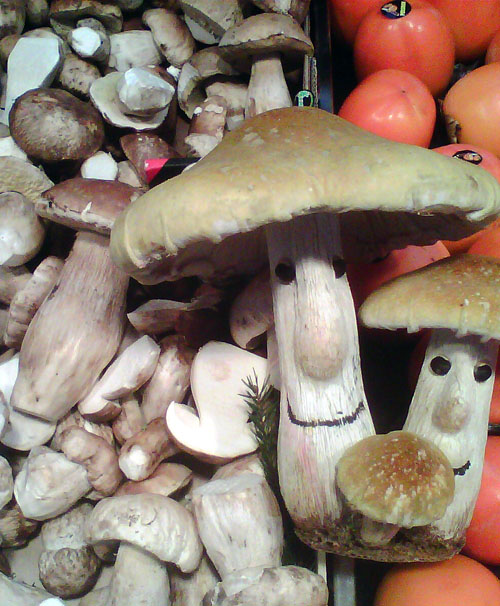 One of the greatest pleasures about living in Europe is the seasonal ingredients I can pick up at the open air markets on my way through the central city. Seasons are truly embraced here in Bavaria and meals (even restaurant menus) are planned around the local ingredients available at the time. At the moment porcini mushrooms abound and you can also pick them in the forests yourself if you know what to look for.
In Germany they are called Steinpilz (stone mushrooms) and I love how the vendor around the corner from my office carves little characters into his porcini display.
This morning I celebrated the snow with some of the mushrooms I bought from this stall, sautéed in butter and relished on toasted Bauernbrot (farmer's rye bread) for breakfast. Apparently these mushrooms also have powerful anti-viral properties, which is a perfect health perk for me as my body gets used to this sudden drop in temperature.
Everything is so quiet when it snows. Almost like a hush that highlights special moments such as unwrapping the brown paper from my fresh porcino mushrooms and savouring the aromas as it melts into the butter - and later, in my mouth.
I've saved a few mushrooms for making pasta later so I can set off its earthy, nutty flavours with a glass of red wine, or a little grappa, as the afternoon unfolds.
Wednesday, October 10, 2012
Rollercoasters and bubbles at the Oktoberfest

However, there's a whole festival going on outside the tents, with rollercoasters and games, as well as food and wine and cocktail stalls spread out across the Therisienwiese festival grounds.
I can't help thinking that it might be a bit dangerous to walk underneath those rollercoasters.Just because I can imagine how I would feel up there after a couple of those massive beers. However, I do think the rollercoaster riders are probably well regulated by the German officials. Still, better safe than sorry.

I didn't make it to the Weinzelt this time unfortunately. Perhaps because I haven't made too many wine drinking friends in Munich. I've also been told that that the wine crowd can be quite schiki-micki (snooty) - but, hey, if someone wants to think I'm posh because I like to drink bubbles, then that's totally ok.
It is, in fact, a relief to see women all around the Wiesn standing around with glasses of wine and bubbles from the stalls. I do tend to agree with my Cape Town friends who insist that wine and bubbles are a lot more feminine than beer.
They were horrified to hear that I drink beer in Munich: "But, uhm, that's just not very sexy at all!"
I've been throwing myself into the Munich beer culture in order to experience the city in a truly authentic way. While I still struggle with the jugful quantities I find that I actually like dark beers most. It really is a special experience to sit in a beer garden under the chestnut trees, or at a beer tent at the Oktoberfest trying to master the Maß.
And yet, I'm still a wine aficionado at heart.
Saturday, October 6, 2012
Oktoberfest party at the Paulaner

Not that we sit down for long. The reservation is for around 4pm and after the first round of beer, a host of Bavarian snacks makes it to our table, including cold roasted pork, sausages, cheese, radish, horseradish and gherkins. Of course, there is also the giant bredzels to go with those giant beers. Who knows where these Germans put it all! The food keeps on coming: roast chicken, cheese Spätzle (a dumpling style German pasta), Knödel (a large round potato dumpling served with brown sauce) and Kaiserschmarrn (a sweet shredded pancake topped with raisins and a sifting of icing sugar).
 In true German style, we all politely finish our meal before jumping onto our table and dancing to the foot stomping beat of the brass Oompah band. The girls all have cute little beer mug accessories (as in the photo above) so that they can easily pick out theirs from the line-up. These mugs are heavy, so you have to put them down every now and again, especially while dancing - and it helps to find yours again when it's colour coordinated with your outfit.
Listening to German music usually makes for a good way to practice my language skills, but these songs are pretty elementary - 'now we jump, now we swim, now we all hold hands', etc.
"Yes, it is almost like music for children - because when us Germans drink lots of beer we think like children," my Bavarian friends comment, while following the communal moves to what seems to be an Oktoberfest favourite.
It's really funny how cheesy a lot of German music is. Dramatic love songs are highly esteemed. I also find out that the popular song 99 Red Balloons was originally recorded in German, as 99 Luftballons by the band Nena. The Oompah band plays a whole lot of songs with mock lyrics set to popular tunes. I even pick up a few South African favourites such as Laurika Rauch and Miriam Makeba - although the German versions are naughtier than the originals.
By the time the tent closes at 10pm, I've had more than my fill of food and beer and fun - but of course, no true Bavarian party is complete before a shot of schnapps. It's a killer, but at least I can say I survived Oktoberfest with the locals.
Sunday, September 30, 2012
Inside the Hofbräu tent at Oktoberfest

As Hofbräu is probably the most internationally famous of Munich's six main breweries, this tent is generally known to be frequented by international Oktoberfest visitors. My Australian friend feels right at home and I also spot some of my American and British expat friends around - it is not everywhere in Munich where you hear that much English! The Hofbräu tent is also one of the first beer tents on entering the Oktoberfest grounds so getting stuck in there with a Maß (one litre beer mug) or two isn't unlikely, even for the local Bavarians.
 While some people are very particular about which tents to go to and book their favourite spots months in advance, we are lucky to get a table at all, at any tent for that matter. The Hofbräu tent can accommodate up to 10 000 people inside and it's pretty crowded. Outside in the beer garden around the tent there's a bit more breathing room and its the perfect spot to sit down for a bite to eat. I am also happy to notice that the food prices here are not inflated for the event and it is possible to find some decent Bavarian food at the same prices as you would at the beer gardens around town.
My Thai friend Pree doesn't really drink alcohol but in the spirit of the Oktoberfest she agrees to try a Radler, a half-half mix of beer and locally made lemonade. In fact, even Rebecca makes big eyes at the Maß and we all decide on an easy start. Radler is also served in a one litre mug and it's the only way really for me to keep up with the beer drinkers.. It goes down well with our shnitzel, which arrives with a hearty serving of Bavarian potato salad and red currant preserve.
Soon the girls are green with dirndl envy. Yes, when you're sitting there in your jeans and everyone else is wearing pretty Bavarian dresses you do feel somewhat out of place. And especially when everyone is having so much fun, it is even more tempting to get into character and jump on that table to dance along with the rest. On a Sunday most shops in Bavaria are closed but for Oktoberfest emergencies such as this, there are a few shops and stalls selling dirndls and lederhosen around the Hauptbahnhof.
What fun seeing them transform into Bavarian goddesses! There's yet another few days of Oktoberfest ahead!
Tuesday, September 25, 2012
Oktoberfest is both savage and beautiful
 I'm surprised. Oktoberfest is not just about drunk men passing out in ditches. Of course, that's there too - but there are many other really lovely things about the festival. Even if you don't like beer.
Top of my list are the costumes. The costumes, the costumes, the costumes. Besides the fact that Bavarians love to dress up in Medieval outfits for festivals, the Oktoberfest is probably best known for the 'tracht' or traditional dress.
For women this is the dirndl, a corset-like dress worn over a short blouse and accessorised with an apron. Older ladies from the Bavarian countryside often still wear this as an everyday outfit - and it is especially popular at formal occasions such as weddings or the church on Sunday.
During the Oktoberfest and other traditional festivals in the area, young girls also embrace the tradition and start planning their outfits months in advance.
 Men wear lederhosen, which is simple raw leather shorts with suspenders (in the picture on the left two savages in their lederhosen are taking part in the hunters' parade). Bavarian men especially like to wear their traditional dress as a habit and it has become somewhat trendy, even amongst youngsters.
Guys often wear their lederhosen around town, at beer gardens - and to watch Bayern Munich play footie. As much as I'd like to be able to make fun of it, there's no denying that these pants really do look quite good on a sporty male figure.
Bavarians are very proud of their history and traditions. It simply takes a walk around Munich city centre to see the selection of designer dirndl shops, Bavarian food markets and, well, beer gardens. This deep love for their culture is also reflected in the popular parades during the launch weekend of Oktoberfest, where various traditional outfits are showcased.
 What fascinates me even more than the outfits, are the hair styles, hats and hair accessories. There are plaits in all colours, shapes and sizes, a lot of silk and velvet ribbons, flowers, feathers, shiny beaded headdresses and even pom-poms. Unless Bavarian ladies learn special hair styling skills from a young age, the hairdressers in Munich must be really busy over the Oktoberfest time.
 Since Bavaria is a strict catholic society, a lot of locals are not really fond of the tourist perception of Oktoberfest. Though it brings in a lot of money for the city, the Wiesn (as Oktoberfest is known amongst the locals) is a proud celebration of traditional culture.
It is originally meant to be a family occasion and you can still find activities for young and old around the festival grounds. From merry-go-rounds to scary rides, a host of delicious food options, sweet snacks and trinkets - as well as a large agricultural exhibition with a host of farm animals which is very popular with children.
"During Oktoberfest things happen in this city that never normally happen in this city," people like to say, with an annoyed shake of the head.
So, you can tart up the dirndl and pass out in a ditch if you like, but it will make you one of those less than favourable 'things'. Not that the locals don't do sexy. There are so many different dirndl styles, shapes and accessories that it allows just about any woman to channel her inner goddess.
Sunday, September 23, 2012
The best of Oktoberfest - besides the beer
 The world's biggest beer festival is kicking off in Munich this weekend - and its not just about beer.
Traditionally the Costume and Riflemen's parade on the first Sunday of the festival is used to showcase a display of Bavarian history and culture, together with the carriages and floats of the beer landlords.
I arrive at early, with some friends, in order to get a good standing view from the road. The parade starts off at Maximilian bridge but we decide to catch the procession as it comes around the circle at Odeonsplatz, which turns out to be a great spot.
The big names are all here: Hacker-Pshorr, Löwenbräu, Paulaner and Spaten as well as the most well-known Bavarian beer house, Hofbräu - and everyone's favourite, Augustiner. A special kind of beer is brewed for the Oktoberfest, according to strict criteria and of course the Reinheitsgebot. At 6%, Oktoberfest beer is also slightly higher in alcohol than the beer you would usually find at a Bavarian beer garden.
The parade is even more impressive than I expected, with the beer carriages drawn by beautiful horses or oxen wearing bells and ribbons and decorated harnesses. The various brass bands performing in the tents during the festival also do marching renditions of their top tunes.
'Oktoberfest is actually called the Wiesn'
 Some popular German brands are showing off and we are lucky enough to get our hands on some Lebkuchen (literally: life cakes) as they are tossed from the parade. These gingerbread hearts are as synonymous with the Oktoberfest as beer and is adorned with icing sugar messages meant for your sweetheart. Ours say: 'I love BMW'.
From where we are sitting the parade continues right through the city to the Theresienwiesen (Oktoberfest grounds) where the carriages are parked next to their respective beer tents and the marching bands each go and perform their celebrated tunes inside the beer tents. Local Bavarians, in fact, don't call it 'Oktoberfest'. To them it's the 'Wiesn' - the traditional name of the festival grounds.
There are two 'Wiesn' parades that normally set the scene. The first happens on the Saturday, when the first beer arrives at the Theresienwiesen in grand carriages and floats that also carry the workers and the families of the beer lords. The mayor then opens the event by tapping the first keg and the beer starts flowing freely.
Rain - and an inside tip to watch the Sunday parade instead - kept me away from the opening parade on Saturday. Which turned out to be a good decision - as today's parade was quite the experience. Some say this is one of the most spectacular events of the Oktoberfest - besides experiencing the atmosphere inside the beer tents, of course.
Tuesday, September 18, 2012
Munich's thrilling Michael Jackson memorial
 There's a small memorial park in front of the five star Bayerischer Hof hotel in Munich where the statue of influencial 16th century musician Orlando di Lasso shares his legacy with the late Michael Jackson.
 Fans of the pop singer have turned the statue into an unofficial Michael Jackson shrine, placing mementos, offerings and tribute messages here week in and week out - since shortly after the singer's death in June 2009.
Every so often I see people gathering here to pay their respects. Or simply to marvel at all the fuss. The choice for this specific spot seems to be related to the fact that the undisputed King of Pop stayed at the Bayerischer Hof across the road a few times.
Apparently it all started because the local authorities refused to build a dedicated Michael Jackson memorial in the city - and so some hardcore fans simply hijacked one while trying to raise enough money to build their own.
There is even a Facebook fan page raising awareness for this cause and urging people to become 'messengers of healing the world'. MJ must have made a true impression in Munich to have such a dedicated group of German fans here.
The statue is never without an abundance of fresh flowers and burning candles, handwritten notes, ornaments and photographs in tribute of the singer. What makes it all a bit eerie, though, are the conspiracy theory posters amongst the gushing declarations of love that also seem to take a somewhat religious tone.
Somehow my gut feeling says the whole situation is a bit of a 'Thriller'.
Wednesday, August 29, 2012
Yes, you can surf in Munich

I encountered this famous surf spot by chance during a stroll through the English Garden, a large park in the centre of the city. Time spent in the garden always feels like a bit of a holiday, with all kinds of bands and festivities going on, yet it is still big enough to find some peace, quiet and lots of fresh air.. Next to the bridge that crosses the Eisbach at the Haus der Kunst, there is a man-made standing wave - about a metre high - where experienced surfers keep going as long as their balance hold. Apparently this is trickier than it looks.
The Eisbach surf wave is not the only surf spot in Munich either. At first I thought it was a joke when I heard that Munich is a bit of a surfing hotspot - but indeed the river surfing opportunities draw surfers from far and wide to try something more than just a little different.
At the Wittelsbacherbrücke on the Isar River there is another very advanced river surfing hotspot. It is close to one of my favourite cafes, Zoozie's. The river wave here is natural and only suitable for surfing after heavy rain. However when the conditions are right it is a very popular spot for Munich's surfers.
Not that surfing is generally the safest sport on earth - but river surfing in Munich can be exceptionally dangerous because of the shallow water and the rocky river. In fact, surfing in the city was forbidden for this reason until the summer of 2010. Since then the famous urban waves have added another feather in Munich's tourist hat, both for the surfers and the spectators.
There is another smaller wave close to the Thalkirchen where it is possible for beginners to learn the tricks of river surfing, although it is not exactly encouraged. At the same time it is possible at a push find surf board for hire in the city - but they do charge for damages and the boards often break on the rocks. It depends on how badly you want the experience, I guess.
Somehow, having the surfers running around in their flip-flops and wetsuits make me feel even more at home in the city - and while the imminent danger of the rocky shallow water adds to the adrenalin rush, surely surfing with sharks in Cape Town takes a bigger daredevil!
Sunday, August 26, 2012
Summer in the Berchtesgadener Alps

Incredible, I tell you.
The white patch of sand in the photo may seem just as out of place. A beach in the middle of the mountains? Well, sort of. The Alps around Berchtesgadener is home to an abundance of white quartz. This may be why the sand in the area tends to be white, especially around the glittering lakes. The water coming from these mountains is known to be the purest in the whole of Germany - and Germany's water is rated pretty high in general. Swimming in a lake as crisp fresh as this after two days of intensive mountaineering is a regenerating experience to say the least.
But - let me start at the beginning. We (myself and a couple of expat friends) made a three hour train trip from Munich to Berchtesgadener - home to another fantastic beer brewery, just by the way. From here we walked along a footpath that follows a mountain stream running into the Königssee (King's Lake). We continued our journey by boat halfway down the lake to St Bartholomew, a small pilgrimage church and inn. I was totally enchanted by the epic surroundings - yet the challenging climb ahead quickly brought me right back down to earth. The Alps may be pretty - all butterflies and forget-me-nots - but they are deceiving. Every time I thought we had reached the top, there was another climb ahead. My thighs were complaining but my eyes were (almost) in heaven.
Heaven being the view from the Kärlinger Haus mountain hut - once we finally reached it. The tiny little Funtensee (Funten Lake) was almost like a dream image, greatly enhanced with each sip of well deserved Berchtesgadener beer. All the hikers at the hut were on a tangible high - there's something about the fresh air, the altitude and the gentle yet challenging beauty of it all that is a total rush.
At the end of our two day hike, after our swim in the lake on the picture above, we rewarded our tired bodies with a smoked trout meal at a pub around Königssee. Slow food, locally caught, smoked and cooked. Here, we lingered a little longer than planned, unsure whether we were too tired to rush, or too reluctant to leave. I may need a little time to recover, but there may just be another Alpine mountain ahead.
Saturday, August 18, 2012
Could this be the best mustard in the world?

Luise's mother-in-law was the mastermind behind the famous recipe. It seems simple enough: water, sugar, mustard seeds, vinegar and spices - but of course, only a Händlmaier could know the true quantities and the secret ingredients that bring it all together so famously. Back in 1914 the aim was to develop the perfect mustard to go with weisswurst (a white Bavarian sausage that makes a popular breakfast together with the traditional brezel).
Little did Luise know just how her legacy would live on.
Today Händlmaier is the mustard of choice for many. There are even a few noteworthy Händlmaier mustard fan clubs in the USA. Perhaps this is about as good as it gets for the hotdog. I expected more of a wow moment when tasting Händlmaier mustard for the first time, but the tube I bought has been growing on me. My Händlmaier of choice is the sweet and spicy version. It is a coarse-grained and tangy mustard that works wonders in combination with any mild sausage, of which my favourite is the Nürnberger.
If you're ever in Regensburg and feel like popping in, the shop can be found in Untere Bachgasse right in the centre of town. It is a small, unassuming little store where you can taste all the different kinds of Händlmaier mustard with bread sticks and buy gift packs or different kinds of mustard in various types of packaging. The standard mustard tubes, however, are available in stores and supermarkets all around Germany.
If you've tasted Händlmaier mustard, let me know what you think!
Sunday, August 12, 2012
Regensburg's angels

I didn't pay much attention to the music session right away. However, as my friend Gina and I made our way around this fairly unassuming church, we kept finding reasons to stay and soon found ourselves completely overwhelmed by the rendition of Ave Maria, magnified by the church organ and the acoustics of the building. The deep and peaceful voice immediately set the tone for the rest of our day.
The Neupfarr church itself is a parish chapel built on top of an old Gothic synagogue built on top of a Medieval Roman church. So, while it is not as visually overpowering as other structures in the area, it said to be built on one of the most historically rich sites in Germany - which also yielded a large collection of Medieval coins.
Gina and I ended up spending the rest of the day church hopping in Regensburg and the incredible thing is that not one of them looks the same - even in the slightest. Some are white and light, others are pink and bright, while we also found ourselves inside some dark and mouldy places where I was gasping for air.
 Just around the corner from the Neupfarrkirche lies the Regensburg Cathedral, one of the most famous Gothic buildings in Bavaria. It is majestic and beautiful, but also be somewhat eerie, especially with all the skeletons and and evil looking creatures making their appearance in the design of the building. The cathedral, however, is also home to the popular smiling angel - created in 1280 by a sculptor known as the Master of St Erminold. She looks particularly cheerful, especially in such dark and dramatic surroundings.
 It's a little bit like information overload to spend time in such diverse and elaborate churches. There is so much detail and I'm sure it would be possible to notice something different no matter how many times you enter through those heavy doors. I always strain my neck trying to look at the roof paintings and I wish it would be possible to just lie down on a church bench and stare at the roof paintings and sculptures for hours. Of course, such behaviour would not be welcomed in these kinds of environments so I simply try the next best option and take as many photos as possible so that I can enjoy them later.
On this trip, one of my favourite things by far was the little angels (as in these photots) perched on the pillars and looking down from the church ceilings in all shapes and sizes and colours. A little reminder that there are pure hearted creatures out there that help us get by. Friends, family and, sometimes, angelic voices that knowingly and unknowingly help us find our way.
Sunday, July 29, 2012
When in Munich, follow the music

Some of the most beautiful things about Munich are chance encounters - walking home on a summer's evening and being lured by the sound of a classical street quartet around the next corner. Or a travelling trio livening up the tedious wait for an underground train with a few chords on a Spanish guitar.
Someone told me in passing that the Munich locals sometimes dance at the Diana Temple in the Hofgarten (Court Garden) - weather depending, of course, as this is an open air garden structure. And on this summer's evening Gina and I decided to pass through the Hofgarten on our way to dinner.
 It was full moon - and the summer air was thick with humidity and magic.(I know, almost over-the-top romantic but somehow these kinds of moments really do take on a surreal sort of edge).
Gina and I crossed the Odeonsplatz and lingered for a while to take in the passion that a pianist brought to the evening. However difficult it must be to transport heavy musical instruments such as a grand piano, it is so worth it from a spectator's side. These kinds of performances make classical music, theatre and even opera freely available to anyone and everyone - right there on the sidewalk - and adds an incredible soundtrack to the city.
From Odeonsplatz we continued into the Hofgarten. As we got closer to the Diana Temple the tango music increasingly possessed the air around us, gently willing us into a silent awe. Candles flickered on the temple tiles and dancing shoes carefully moved across the scattering of rose petals, infusing the air with the sweet smell of flowers.
And there she was, the girl from the train, dancing the tango as though in a trance, her eyes filled with a collected madness - as though there was no other person in the world but her partner and no other moment than this.
I remain but a spectator, the story teller rather than the story - but moments like this remind me that, just sometimes, its worth taking a step back from this mad rush we call life. There are moments that require one to be truly present. To own your moment. To live with abandon. And to keep dancing even if everyone's watching.
Monday, July 16, 2012
A little Rhine and a lot of Riesling

My daydreams of sailing around the world turned into
a nightmare a long time ago already. I've always been the one turning green at fancy
yacht parties and missing out on all the champagne. The rhythm of the deep sea
simply never clicked with me.
On a recent weekend trip to visit my friends in Mainz however, the peaceful flow of the Rhine River
When it comes to water, I have no need for speed - but I had to
learn some trust. My daredevil friends recently passed their boat drivers'
licenses as a group and now found a new weekend hobby: hanging around on boat
jetties in their nautical outfits and taking turns to play captain.
At Heidenfahrt, a boating community which is part of the
Heidesheim am Rhein area, the spacious Rhine River provides a wide water track for boating enthusiasts. Not everyone prefers
slow motion barging like me and of course there were times when I had to hold
on - and even when I had to hold the wheel for a while, heart beating like a
cuckoo clock.

It's a kind of high evoked by all the fresh air and the
speed of the boat gliding across the river and the sparkling water and the
pretty historical towers peeking out from the beautiful green riverside
surroundings - almost like a holiday for the eyes.
Back at the Heidesheim camping and picnic area the rest of the group claimed a spot for a nice bratwurst grill in between the boating and wakeboarding escapades. It was the first time since moving to
The Mosel valley along the Rhine produces some award winning Riesling wines and I really enjoyed mouth-puckering fruity but dry sensation of the Peter & Peter Riesling - though it probably would have been a better match with seafood, it made a great sipping wine with a (coincidentally fashionable) yellow-green colour.
We grilled bratwurst and pork steaks and enjoyed it with a selection of homemade salads and potatoes and Italian tomatoes stuffed with garlic, fresh herbs and feta. The wine flowed freely and we ate slowly and in stages throughout the lazy Saturday afternoon.We were also lucky enough to find a gelato and espresso kiosk on the camp site, in order to round off the indulgent meal in a typically European way.
We grilled bratwurst and pork steaks and enjoyed it with a selection of homemade salads and potatoes and Italian tomatoes stuffed with garlic, fresh herbs and feta. The wine flowed freely and we ate slowly and in stages throughout the lazy Saturday afternoon.We were also lucky enough to find a gelato and espresso kiosk on the camp site, in order to round off the indulgent meal in a typically European way.
Of course, my favourite is always German chocolate. Which remains a good ending to any great getaway day - land, river or sky.
Saturday, July 7, 2012
Das Leben ist ein Ponyhof (Life is a rose garden)

Which is funny because my friend Susi owns a pony and regularly invites me along to spend time on the 'Ponyhof'. Where there are also lots of roses around now that its summertime in Germany.
So I say; life can be whatever you want it to be.
 In fact, on a recent trip to Nonnenau (Nun's Island) where Susi used to stable her pony, I had the feeling that I stepped into a bit of a fairy tale. Nonnenau is on the Rhine River close to Mainz in the Frankfurt area.
We took a short ferry ride to get to the island where I was enchanted by the historical buildings and the apple trees - which made me think of Snow White.
Then there was this lovely thoroughbred peeking out from its little 'palace tower' overgrown with red roses - Rapunzel, of course. Or is my imagination taking things a little too far?
I was lucky enough that here was also a small pony for me to ride. Henry. Whom I proceeded to call Prince Henry, because the setting called for it. So Susi and I took off through the apple trees on Nonnenau, managing to avoid the poison apples and the evil witches and opting for a beer at the small beer garden on the island instead.
Nonnenau is a delightful little river island which also seems to be a popular setting for events and weddings. Which is no wonder. It has just the right amount of magic for the imagination to run free and perhaps dream up a happier-ever-after destiny.
Friday, June 29, 2012
My local beer garden: the Paulaner am Nockherberg

The Paulaner am Nockherberg is one of these old characterful breweries that used to be a monastery. There is a lush garden at the bottom of the small hill, with a staircase leading up to the beer hall. Its all old and quaint and not the way I would have pictured a beer garden at all before moving to Munich.
Monks started brewing beer here in 1634 - all only for themselves (about two hours out of town, at the Weltenberg Kloster cellar, they referred to beer as some kind of elixer of enlightenment). At some point the Nockherberg stopped being a monastery and a few years ago the Paulaner took over this cellar known at the Salvator-Keller. They brew a strong, dark beer here known as the Salvator, which is very propular.
Of course, as with most true beer gardens in Munich, it is not possible to order any smaller quantities of beer than a Maß (pronounced 'Maz') - which is a one litre mug. I'm getting better at holding the Maß, which is good, because Oktoberfest will be coming up soon and I need to be ready. Though I still prefer to go for the Radler, which is a type of shandy premixed with local lemonade in the barrel. I do like the taste of Bavarian beers, expecially the dark ones, but it's the quantities that get me. Bavarians don't really see beer as alcohol though, it's merely an important part of a good, healthy diet.
Many beer gardens in Munich don't serve food, a long standing tradition that is meant to protect the restaurants in the area. At the Nockherberg, though, they serve large portions of Bavarian delicacies. German sausages, brezen, deer and, at the moment, the delicious seasonal white asparagus. It is also here where I discovered the large, over-sized brezen. They are bigger than an average dining plate and make a good, salty snack to have with beer.
In fact, a beer and a brezel is more than enough of a dinner for the average lady - although, sometimes I still miss my mussels and bubbles dearly. Perhaps its time to explore a little bit beyond the city of beer.
Sunday, June 10, 2012
It's all in the wrist of the beer holder

I watched Saturday's Germany-Portugal football game with some German friends at the Paulaner am Nockherberg in Munich. Here the options were one litre beer mugs, or nothing. Having freshly moved over here from the Cape wine country, I am still getting used to drinking beer. Never mind those massive glasses.
When it comes to beer and football it seems the only options are; go big or go home. The problem with that is that I found myself utterly lacking in beer holding skills. While some of the women there were walking around with up to four beers held in one hand, I used both hands to support my beer when no one was looking.
What's more, with my consistency the party would have been over pretty soon if I had to finish a few litres of beer back to back before they get warm. The trick for keeping up with the drinkers and still have a beer at hand for a toast at any given time was to order the Radler, a (more or less) 50/50 mix of beer and German style lemonade. Quite refreshing and, of course, easier on the already high percentage of alcohol typical of the Bavarian beers.
It was all fun and games at the Paulaner am Nockherberg until the German football team set foot on the pitch. There was a lot riding on this game, especially for the Bavarians. Some winning celebrations were still outstanding after that recent doomsday at the Allianz Arena. This Euro 2012 game was a real nail-biting one too and everyone's eyes were silently glued to the big screen right up until the moment when German striker Mario Gomez scored a goal in the second half.
The only other time when I have ever seen that much joy and passion from the normally reserved German people was during the 4-0 win over Argentina in the 2010 World Cup in Cape Town. Perhaps the recent study by a Cologne based research institute is wrong. Germans are not lacking in 'joy genes' or pleasure DNA; they are simply selective about where they find their joy.
Street parties in the city lasted until late into the night and we ended up dancing off the beer (to cancel out all probability of a beer belly, of course) somewhere in the VIP area of a nightclub. While the absence of beer jugs here was a huge relief, my wrist still ached way more than my head today.
Sunday, May 27, 2012
The hills are alive with the sound of Mozart
 It must be all the oxygen-rich Alpine mountain air that made us do it.
My
colleague Gina and I made the crazy call to hike up the Salzburg city cliffs after a busy morning
discovering some Baroque churches. Our Wiener schnitzel lunch bite, which was
meant to be sustenance for the journey, simply seemed to add an extra body drag.
Yet we were determined to see the view from the top and to
the other side of the cliffs. Our destination was the Festung Hohensalzberg (below), a
medieval fort that dates from 1077 and overlooks all of the pretty cathedrals and
castles which we visited in the morning. The path was a really steep one interspersed
with steps. For me it was interesting to note that although it was a really hot
summers day, the air was still fresh-fresh and while we were out in the sun exerting
ourselves for around 20 minutes, I never found myself sweating.
Finally, there it was: a picture postcard view of the city’s
cathedral and castle towers framed by the Salzach River. The city cliffs also mark the northern edge of the Alps. From high up on the fort’s
look-out point, we had an extended view towards the opposite side where cloister
gardens and parks lead up to the snow-covered Unterberg peak (in the picture). Salzburg is in fact named after the Alpine salt that was
carried on barges all the way from the Hallein mines near the city, via the Salzach
River.
On the way down we quickly realized that the sandy path is
certainly not meant for princesses. While we were both wearing flat shoes it
was still a bit slippery. So we made our way around to a place that is actually meant for princesses, the Mirabell Palace. Here a classy interior with very shiny chandeliers made me feel
like wearing Baroque gowns and hats and white lace gloves. There are many photo
booth areas around the old city where you can dress up in these outfits and get photographed in the
glamorous old-style.
 Next to the Mirabell Palace is a romantic Baroque garden. Salzburg was the setting
for the Oscar winning film, The Sound of Music – and the mythical Pegasus fountain and unicorn steps in the palace garden
is where Maria and the children performed the famous 'Do-Re-Mi'. The Hollywood film was banned in both Austria and Germany because of the war reference. The film has been such an integral part of my childhood, yet my German and Austrian friends have no frame of reference for the songs and the context. At the end of last year, a play based on the movie was staged in Austria for the first time though apparently it is mostly booked by tourists.
Next to the Mirabell Palace is a romantic Baroque garden. Salzburg was the setting
for the Oscar winning film, The Sound of Music – and the mythical Pegasus fountain and unicorn steps in the palace garden
is where Maria and the children performed the famous 'Do-Re-Mi'. The Hollywood film was banned in both Austria and Germany because of the war reference. The film has been such an integral part of my childhood, yet my German and Austrian friends have no frame of reference for the songs and the context. At the end of last year, a play based on the movie was staged in Austria for the first time though apparently it is mostly booked by tourists.
We saw no less than three weddings throughout the day
and I would imagine that the garden gazebo, which was reconstructed in a studio
for the filming of ’16 going on 17’, makes a popular wedding photo setting.The garden also has a lovely pergola and hedge theatre, which makes an intimate setting for stage shows.
Salzburg
is also the birth place of Mozart. Besides a monument dedicated to this maestro, there are classical music concerts happening all
over the city, including the Mirabell Palace. Street musicians randomly perform impressive classical concertos and music generally resonates from all over the old city, creating a classical
soundtrack wherever you go.
Horse carriages, which can be rented for special occasions or tours, add to the old-world feeling of Salzburg. It really is one of the prettiest cities I've seen and while I feel I've ticked all of the tourist boxes, I would love to go back just to step into that fairy tale world again and listen to Mozart.
Sunday, May 20, 2012
A display of Bavarian summer: pretty flower boxes

Until I moved to Munich.
As with many other apartments in this German city, mine has a balcony with flower boxes. These tiny explosions of colour brighten up residential areas all over Europe. For me, flower boxes really are one of the prettiest things about the summer here. While the public city gardens also celebrate the sunshine with impressive displays of colour, flower boxes are a sort of personal contribution to making the season look even more festive.
For me, it is super exciting to be on the inside making a planter box of my own and not just a passing outsider admiring them.While I arrived in Munich slightly too late in the year to grow my flowering plants from seeds, it was easy to visit a nursery next to the Isar and choose a couple of multi-coloured flower trays. I double checked to make sure that all the elements of my mix & match flower tray palette would be happy to greet the morning sun. Soon I made my way home with arms full of plant trays and flower food.
I never thought it would be this rewarding to see the result of my instant garden. In fact I have never been so excited to see a few flowers in a box. It might be a humble start and only time will tell if I can keep the pretty flowers happy. However, the simple task of choosing and planting them has evoked in me a feeling of joy that makes me wish I can invite my gran for a cup of tea right here on my flowering Bavarian balcony.
Subscribe to:
Posts (Atom)


